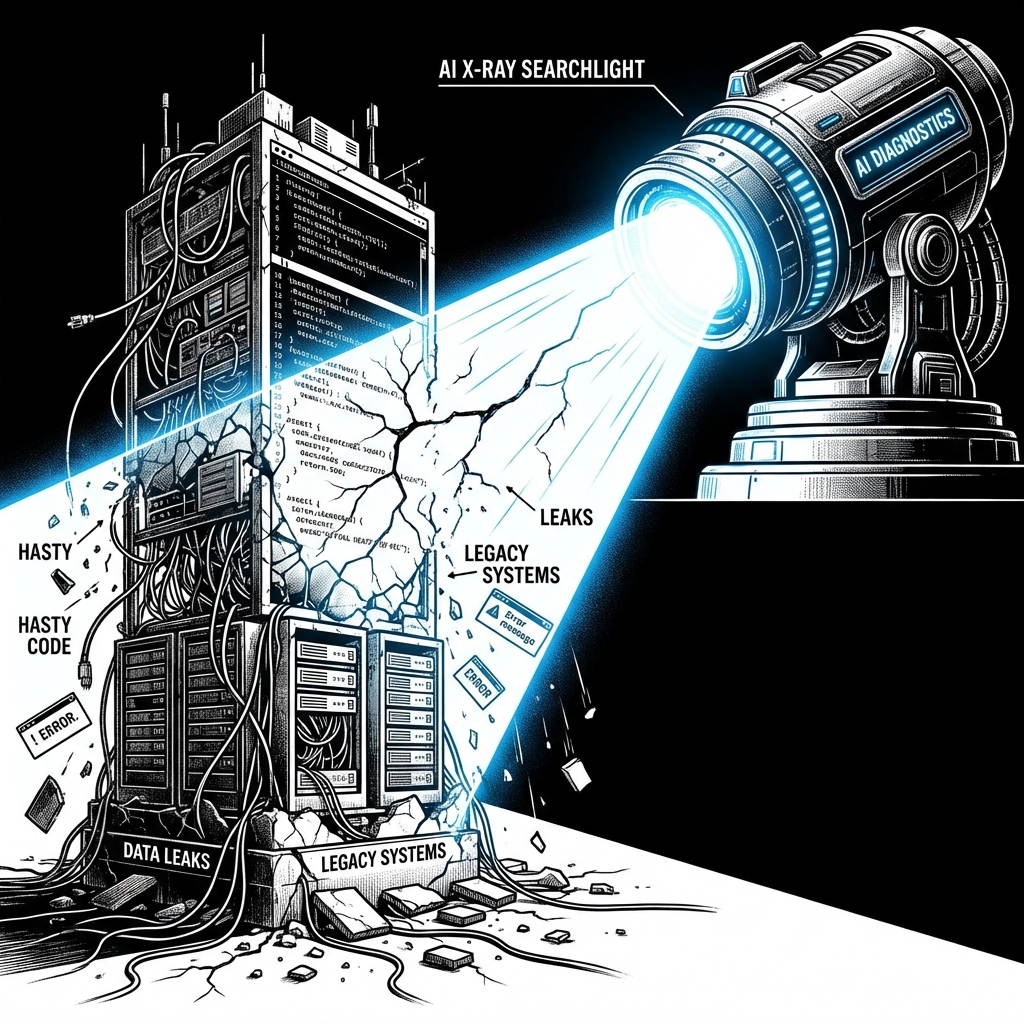
AI Exposes Weak Projects, It Doesn't Replace Them
There is a pervasive fear that AI is coming for our jobs effectively because it is "smart."
This is a misunderstanding of what Generative AI actually does. AI is not coming for the smart jobs first; it is coming for the rote, the repetitive, and the mediocre. It is a solvent that dissolves "average."
If your project—be it a website, a business model, or a code base—is built on weak foundations, AI will not fix it. AI will accelerate its collapse. This is because AI acts as a multiplier of existing processes. If you multiply zero, you still get zero. If you multiply a flaw, you get a catastrophe.
The X-Ray Effect
When you try to integrate AI into a legacy system, the first thing that happens is not "innovation." The first thing that happens is that every dirty secret of your data architecture is revealed. Inconsistent tagging? Revealed. Siloed databases? Exposed. Lack of clear documentation? Painfully obvious.
Humans are good at compensating for bad systems. A human employee knows that "Client_ID" in one spreadsheet is the same as "Cust_No" in another. They make the mental leap. An AI model does not make that leap unless explicitly trained to do so. It simply hallucinates or fails.
Therefore, the process of adopting AI is actually a process of forced structural honesty. You cannot lie to the model about your data structure. It forces you to clean your house.
The Mediocrity Trap
Many companies are rushing to use AI to generate content and code. They believe this is a shortcut to scale. "We can now write 100 blog posts a day!"
But 100 mediocre blog posts are not an asset; they are a liability. They dilute your brand voice. They bloat your sitemap. They signal to users (and search engines) that you have nothing original to say. The weak project uses AI to hide its lack of substance behind a wall of generated text. The strong project uses AI to analyze, synthesize, and create tools that were previously impossible.
Replacement vs. Displacement
AI will not replace the architect; it will replace the draftsman who refuses to learn CAD. It will not replace the writer; it will replace the "content generator" who rewrites press releases.
The projects that will survive are those that are "AI-proof" by virtue of their humanity and their structural integrity. Projects that rely on deep human connection, high-stakes decision making, and physical reality. DFSK is an example of this thinking: we do not offer automated solutions. We offer the diagnosis that precedes the automation.
The weak project fears AI because it threatens to do the work cheaper. The strong project welcomes AI because it clears the field of competitors who never really understood what they were doing in the first place.