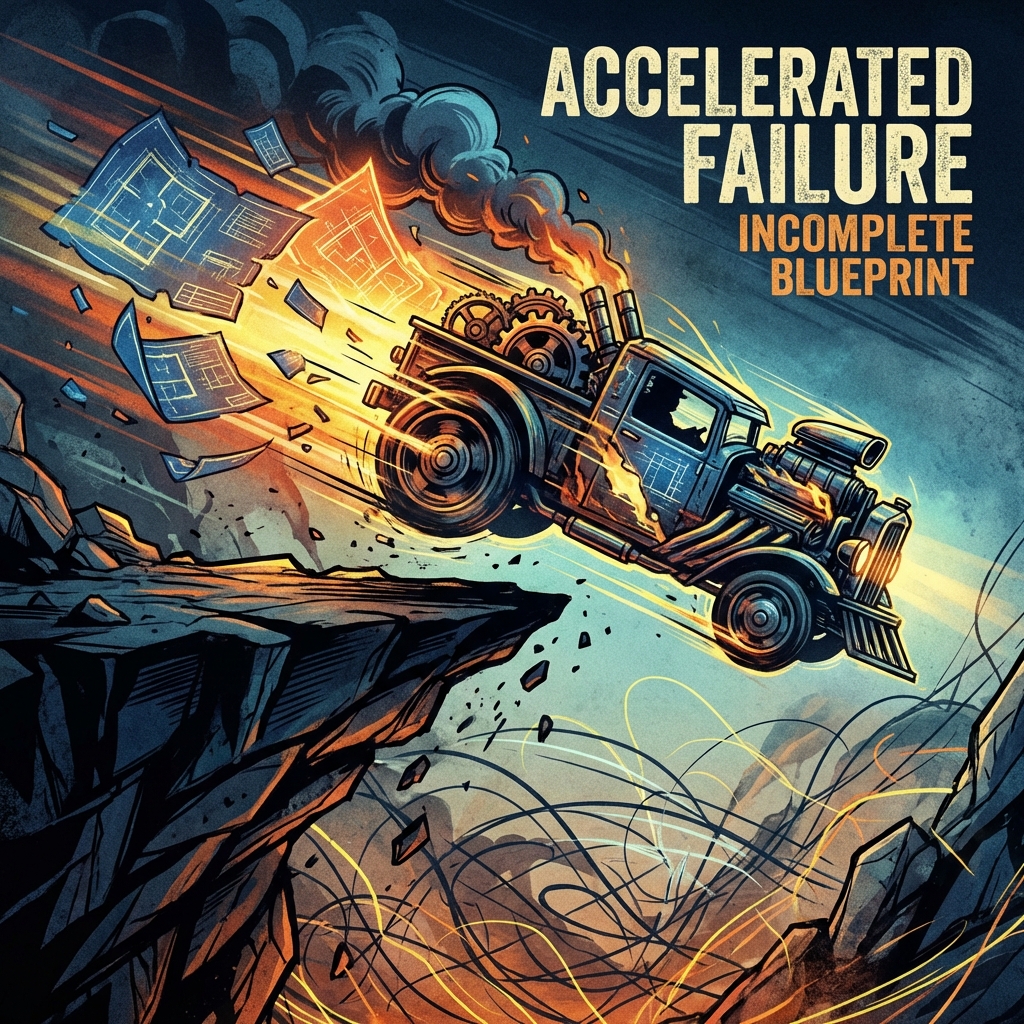
Automating Before Understanding Is Accelerating Error
There is a seduction in the "one-click" solution.
We are sold tools that promise to automate our marketing, our coding, our hiring, and our lives. The promise is always efficiency. "Why do it manually when a script can do it instantly?"
The danger lies not in the automation itself, but in the timing. Implementing automation on a process you do not fully understand is the most efficient way to destroy a project.
The Black Box Problem
When you manually execute a task—say, deploying a server or writing a customer email—you are intimately aware of the variables. You feel the friction. You see the edge cases. You understand the "why" behind the "what."
When you automate that task immediately, you create a black box. You have an input and an output, but the middle is opaque. When (not if) the process breaks, you have no intuition for where the failure occurred. You become dependent on a system you cannot repair.
This is the tragedy of the "No-Code" movement gone wrong. It empowers people to build complex systems without understanding the underlying logic of databases or API limits. It works beautifully until you hit scale, and then it fails catastrophically.
Bill Gates' Law
Bill Gates famously said: "The first rule of any technology used in a business is that automation applied to an efficient operation will magnify the efficiency. The second is that automation applied to an inefficient operation will magnify the inefficiency."
Most organizations are inefficient. They have processes riddled with redundancies and unclear decision trees. If you feed these bad processes into an automation tool (or an AI), you are simply enabling them to make mistakes at light speed. You are automating chaos.
The DFSK Protocol: Do It Manually First
We advocate a counter-intuitive approach: Do things manually until it hurts.
Write the email responses yourself. Manually migrate the data. Hand-code the HTML. Only by feeling the pain of the manual process do you identify the actual bottlenecks. Only then do you earn the right to automate.
This "manual phase" is where the understanding happens. It is where you refine the logic. Once the logic is crystal clear—and only then—do you write the script. The script should be the crystallization of your understanding, not a substitute for it.
The Future of Work
The most valuable workers of the next decade will not be the ones who can simply "use AI tools." They will be the ones who can design the workflows that the AI executes. They will be the systems thinkers who understand the machine well enough to know when to turn it off.